
Make skincare easier.
TIMELINE
May 2026
TEAM
1 designer (me!)
ROLE
Product design
Visual design
SKILLS
Product design
Branding
THIS PAGE IS CURRENTLY A WIP!
01 / Initial Planning
The Problem
Finding skincare that actually works for your skin shouldn't be this difficult.
But the industry is built to sell, not to inform. Influencers promote anything that would give them a brand deal, and marketing is hinged on exaggerations.
The result: Users end up buying based on who has the biggest following, not what they actually need.

Image showing a skincare recommendations app recommending product.

Image showing what ingredient lists of skincare look like.
Even users who do know skincare have a hard time. Ingredient lists are dense and never optimized for a consumer.
Users are stuck choosing between two bad options: trust marketing they know is unreliable, or self-educate through a system that was never built to be understood.
13/20
people discover products on social media.
10/13
find the products ineffective.
9/10
struggle to figure out why.
The Solution
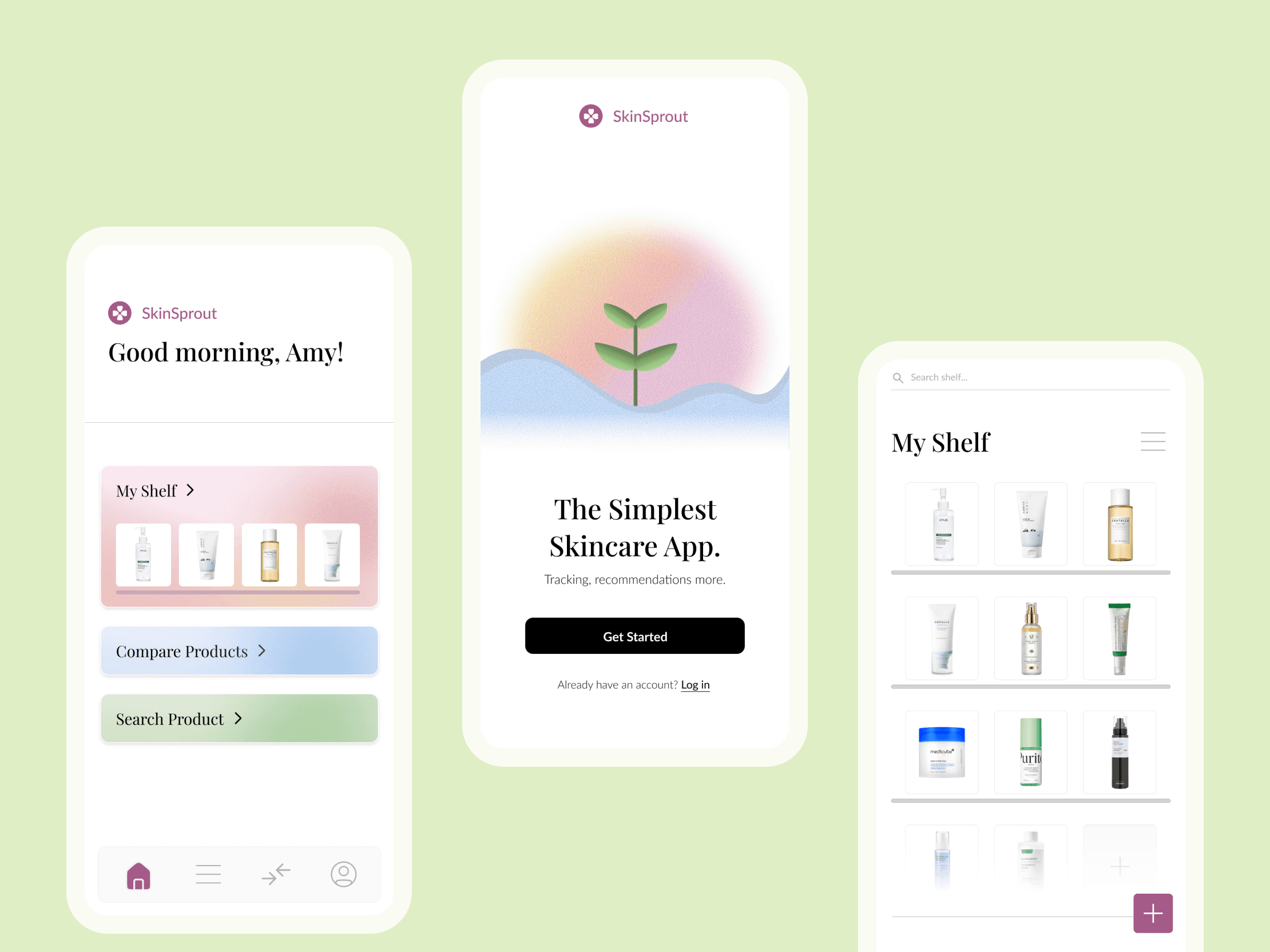
A mobile app that allows users to track products, and recommends future products based on their skincare history.
A tracking system where you can log your skincare in your "shelf".


Product info, based on your own opinions and other general facts.
A comparison page listing out which product is recommended - and the reasoning based on your skincare history.

02 / Research
Affinity Mapping
Through analysis of 20 user survey responses (aged 17-24), I mapped out the responses to better understand the problem.

This revealed 4 key insights:
Too many voices with no way to weigh them.
Influencers, brands, and buzzwords all compete for trust, leaving users unable to tell good advice from marketing.
Generic advice doesn’t work for everyone.
Broad categories like "oily" or "sensitive" hide the fact that two people can react completely differently to the same product.
Ingredients are unreadable, so cause and effect stays hidden.
Users can't connect a reaction to its cause when they don't understand what's in the product to begin with.
Without a record, past products vanish, so nothing gets learned.
People can't recall what they've tried before, and tracking tools don't have enough payoff to motivate real use.
Personas
To truly embody the issue, I created 2 personas and narrowed down our target audience.


Competitive Analysis
Finally, I needed to understand what the market currently looks like, so I conducted some quick competitive analysis!
Problem Statement:
How can we make skincare easier to purchase based on each user’s personalized skincare history?
03 / Design Process
Moodboard
In order to fully understand the vision, I created a mood board. The main inspiration was made of skincare apps and other apps with modern, simplistic UI.

User Flow Chart
I didn't feel the need to make a chart for every interaction as I already had a pretty good idea of what the app should look like. However, I did make one for some areas where I felt unsure, such as how adding new items to the shelf would look.

Branding

Wireframing
I mapped out the screens + flow using low-fidelity wireframes, ensuring navigation was smooth.

Testing
The low-fi was my first iteration to ensure everything made sense. I tested the flow with 5 users who all know different amounts of skincare.
5/5
Completed the flow without any help.
4/5
found the information easy to read.
3/5
Had trouble editing products inside the shelf.
Design Choices
Navigation problem:
Users needed a way to move between stat cards without breaking the visual rhythm of the layout.
Currently, the cards are aligned vertically. Do users swipe, tap, or should they click somewhere else on the screen?

Decision
Despite the vertical arrows having a clear next step, I decided against it because it cluttered the screen too much.
So we went with the no arrow option. Users can swipe or tap to move onto the next screen. The layering is intuitive enough for the next step to be obvious.


05 / Learnings
Research first
This was my first complete solo project. As silly as it sounds, I didn't realize the importance of research in the past (my old workflow was pretty messed up, it was idea —> execution —> maybe conduct a bit of research to back it up). I now know that research is quite literally the most important step in UX. (Maybe I can even say I'm pretty good at it now.)